Much of today’s purchases and transactions occur online. Think about online giants like Amazon, as well as traditional chains with a large web presence like Target or WalMart. Shopping online provides a huge convenience, so long as you can wait for shipping time. Even time-sensitive shopping, like for fresh groceries, can be done online. For example, your author here uses the WalMart grocery app quite regularly. It allows me to do all the shopping online, and then pick up my order from a store. Customers even have the option of having their groceries delivered. On a personal note, I can feel overwhelmed in large stores due to the lighting, and the fact that I’m trapped in a box with SO MUCH advertising! I catch myself wandering and distracted, its a mess. Because of this, I’m a big e-commerce consumer.
Social networking is an incredibly popular way of communicating on the internet. Between social media powerhouses like Facebook and Twitter, Statista.com reports that there were 2.46 billion users of social media in 2017, with projections of 3.02 billion for 2021.
That’s a staggering amount of people, who can use social networking for keeping in touch with family and friends, and interacting with their online community.
Email
Email is a powerhouse in the business world. In fact, having an email address is often a prerequisite to create a profile on the social networking sites discussed above! While not a super common tool for inter-personal communication nowadays (with the proliferation of text and instant messaging), email is a widely used tool for business to interact with customers. Email is widely available, and users can create free email mailboxes from websites like Yahoo, Google, and Mail.com.
Blogs / Wikis
Readers will likely be at least somewhat familiar with blogs, because this is one! Blogs are personal “journals” that can be broadcast out to an audience. Blogs can be found for all kinds of communities, groups, hobbies, activities, you name it! If you have an interest, you can probably find a blog about it.
Wiki’s are also a little similar, in that you can find them on a huge variety of subjects. Wiki’s are intended to be informational in nature (as apposed to strictly entertainment-based) and are drafted and published by multiple authors, typically on the web. A powerhouse example is the ubiquitous Wikipedia, a giant conglomerate of many wikis.
Podcasts / Webcasts
Podcasts and webcasts are another way to reach an audience or community. These have a lot in common with blogs! While blogs are typically text-based, a podcast is based on audio (like a radio show), and webcasts are video-based. A common form of webcasts are “vlogs” you may see on YouTube.
Streaming Media
Quality internet streaming has changed the way many of us interact with media, from music, to television and movies. I’m personally a big consumer of steaming media. I use a subscription to Apple Music to steam music to my phone, giving me instant access to all of iTune’s library, so long as I have an internet connection. All the TV I watch is also streamed, as opposed to more traditional cable options. I use Netflix and Amazon Prime (among others) to stream the shows I want to watch.
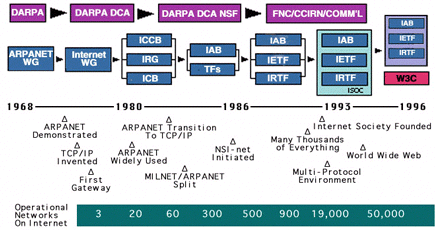
ARPNET (Advanced Research Projects Agency Network)was created by the US Department of Defense to allow transmitting data from computer to computer. This created the building blocks of the modern internet.
1983 – Birth of TCP/IP
The protocol of TCP/IP set a model for how data could travel between networks. If ARPNET in the 60’s created building blocks for the internet, the adoption of TCP/IP formed the skeleton and infrastructure.
1990 – Going Mainstream
Until the 90’s, the internet was a pretty specialized network, and not very present in the public eye. This changed in 1990 with the creation of the “World Wide Web” by Tim Berners-Lee. This began to take form of the internet we know and use today.



 Austin's Tech Adventures